After years of working across luxury jewellery markets, one thing becomes clear: commercially strong jewellery is rarely created by looking at commercial success as the starting point. It begins with strong design thinking.
It Starts with a Clear Idea
Sometimes the client comes with a price point in mind. At times, it is the look, a story to tell, a culture to explore, a target audience to entice or even an opportunity to utilise existing raw materials.
For luxury jewellery brands, jewellery collection design should therefore begin with a question:
What are we trying to do through this collection?
That question can lead the design somewhere much more interesting than simply following the next jewellery trend. The idea gives the designer a direction.
It has to Understand the Customer
And so, market research is the first step.
A collection designed for a luxury retailer in India may need a different approach from one intended for the Arabian Gulf or another international market. Customer preferences, cultural influences, occasions, gemstone choices, scale and retail positioning all affect how jewellery is perceived.
This is where market understanding becomes part of luxury jewellery design. The designer has to know what the customer is looking for without simply giving the customer what already exists. That balance is important.
It needs a Clear Design Direction
Luxury jewellery operates in a crowded visual landscape.
Customers see diamonds, gemstones, floral motifs, geometric forms and statement silhouettes everywhere. Creating something beautiful is no longer enough to make a collection noticeable.
For a design-centric creative house, the challenge is to take an idea and give it a distinctive visual direction. This can come from the way a designer interprets a familiar story or idea, uses proportion, combines stones, creates movement or treats negative space.
Collections such as The Waterfall collection and The Kavya collection begin with distinct design ideas that shape the way the jewellery is conceived and developed.
Jewellery is Personal. It should tell a Story the Wearer Relates to
The customer may be drawn to a design because it reminds her of a place, a feeling, a relationship, a cultural reference or simply something about herself.
The story could be inspired by flora, fauna, geometry, architecture or celestial forms. For jewellery design, the world is the muse.
A strong jewellery collection gives the wearer something to discover in the design.
When inspiration becomes form, the jewellery begins to communicate without words.
It needs to be Recognisable
Does this story connect to the brand?
Commercial success and memorability are closely connected.
A beautiful piece can catch someone’s eye for a few seconds. A memorable design creates recognition.
It might be an unexpected silhouette, a distinctive use of diamonds, a particular rhythm of gemstones or a detail that becomes associated with the collection.
The objective is not to make jewellery louder. It is to make it recognisable.
The strongest luxury jewellery collections leave behind a visual memory. They give the customer something she can remember, talk about and eventually associate with a particular brand.
Creativity has to Survive Reality
A brilliant sketch is only the beginning.
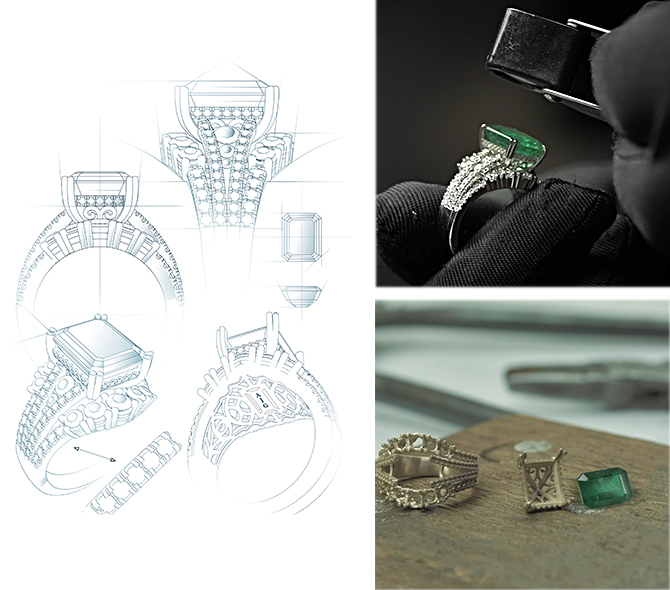
Luxury jewellery has to move from concept to stone selection, proportions, setting, CAD and eventually production. Technical decisions can influence everything from the way light enters a stone to how comfortably a necklace sits on the body.
This is why jewellery design services should involve more than creative ideation.
A design partner for high end jewelry retailers needs to understand how the design will actually work, from the first concept through technical development and towards production.
At AMIT J GHOSH, our high diamond jewelry design solutions bring creative thinking together with technical precision. The design process considers proportions, gemstone weights, metal requirements, wearability and technical development before designs move into CAD and production. This helps protect the original idea as it moves towards reality.
A retailer needs jewellery that can attract attention. A customer needs a reason to want it. And the brand needs something that contributes to its identity.
That is where commercial thinking and creative thinking meet.
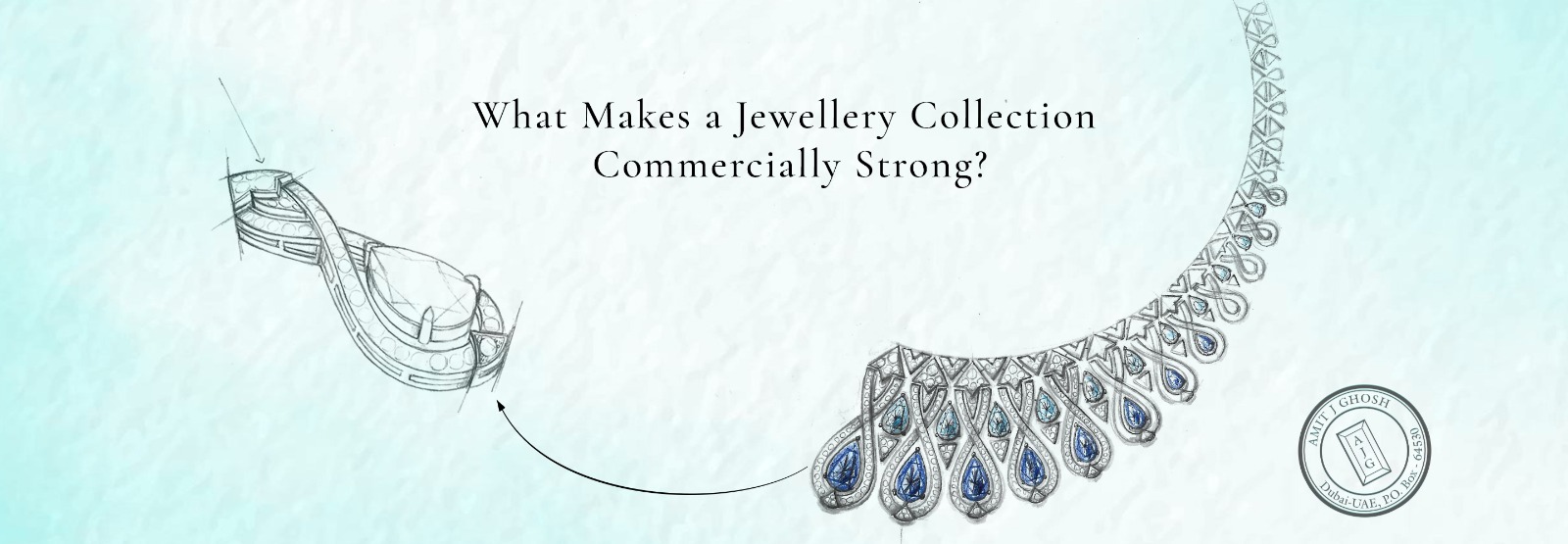
A commercially strong jewellery collection gives the customer three things:
Something to desire.
Something to relate to.
Something to remember.
When those three come together, jewellery becomes more than a beautiful object.
It becomes a reason for a customer to stop, look again and choose.