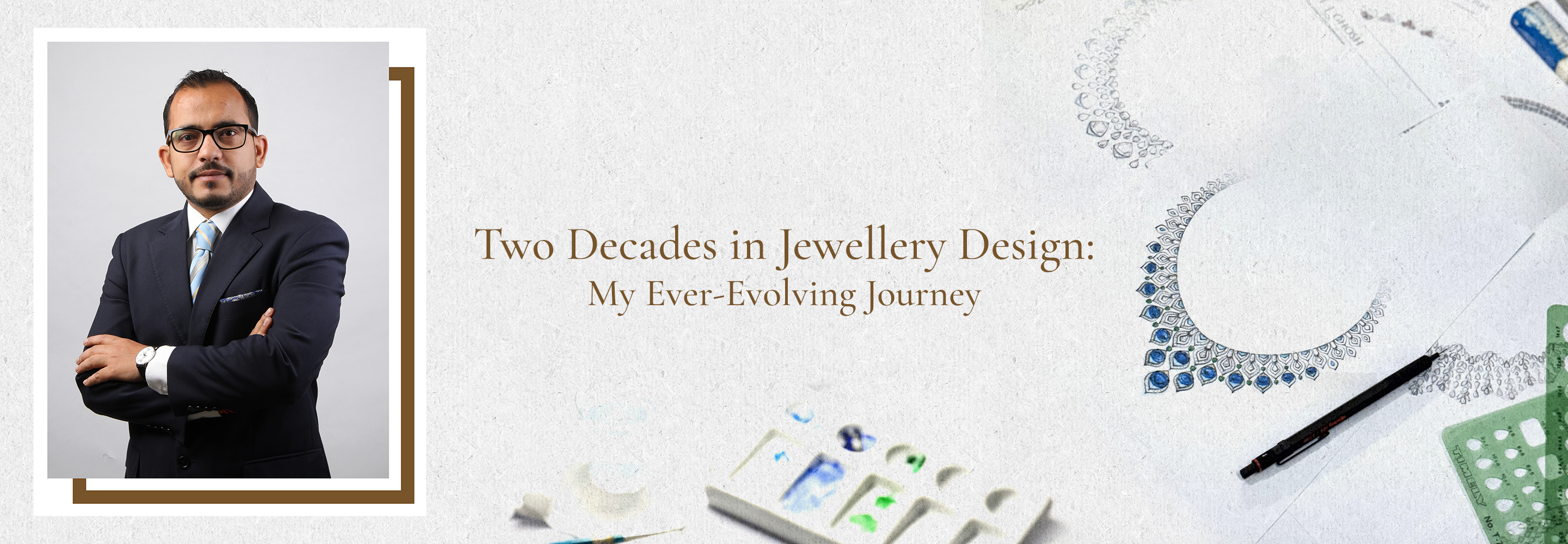
I did not grow up in a family of jewellers. But I grew up around people who knew how to create their own paths.
I come from a small village in Kolkata, where I saw people work hard simply to put two meals on the table. My father ran a family grocery shop, yet he was determined to pursue his education. He would walk miles to college, unwilling to let the circumstances around him decide how far he could go.
Looking back, I think I learnt something important from him. You do not have to follow the path laid out before you. Sometimes, you have to find your own.
Jewellery design was not a career I had planned. It came into my life almost by chance. But I still remember the feeling when my pencil touched paper. Something just clicked. I knew I had found something I wanted to pursue.
What I could not have imagined then was how much the world beyond that sheet of paper would teach me about design.
The World Became My Classroom
I studied jewellery designing, moved to Mumbai and then to Saudi Arabia to explore the field further. However, my experience at Rosy Blue in Dubai opened up a world I had much to learn from. Understanding a brief, developing a concept, travelling to jewellery shows, meeting people from different backgrounds and observing how brands approached their markets gave me perspectives that no drawing table alone could offer.
As an experienced designer in the jewellery industry, I have come to value these experiences as much as the act of designing itself. They taught me to look beyond aesthetics and understand the thinking behind a collection, from its intended audience to the purpose it needs to serve.
Different Markets, Different Design Sensibilities
I began to realise that every market has its own relationship with jewellery. In the Middle East, I often encountered a love for grandeur, strong motifs and designs that make a statement. Baguettes, with their clean lines and architectural character, can be particularly compelling in this context.
In India, jewellery can hold something deeply personal: memories of family, traditions passed down through generations and moments that stay with us for life. Precious stones in different colours and cuts, cultural motifs and personal stories can all play an important role.
European and American markets bring their own set of considerations, where the character of the design, the rarity of the materials and the way they come together can become important differentiators.
The more I see, the more curious I become. Why does one design resonate with a particular audience? What makes another feel unfamiliar? And where might different sensibilities find common ground?
These questions have changed the way I approach design. Research became much more than studying a market. It became a way of understanding people before attempting to create something for them.
When Design Thinking Goes Beyond the Sketch
I remember a project with a leading jewellery retailer that brought us an inventory of substantial precious gemstones for a collection intended for a European audience.
Looking at the stones was only the beginning. I wanted to find a story that could bring them together, something that would give the designs a shared identity rather than leave each gemstone to speak on its own.
Our exploration led us to Venice. Its architecture offered a direction we could interpret through the designs, creating a relationship between the story, the stones and the intended audience.
Experiences like this have shaped my understanding of high diamond jewelry design solutions. The challenge is not simply to create a beautiful piece around an exceptional stone. It is to find the right concept, understand the brief and bring the elements together in a way that feels considered and complete.
Another experience that stayed with me was working with an established jewellery retailer in South India, whose identity was closely tied to traditional, gold-led designs. The retailer wanted to expand its market and approached me as a design partner.
There was an opportunity to explore a more global design direction. But I never saw the challenge as replacing what the brand stood for. Its authenticity was precisely what made it distinctive.
The interesting question was how to take that identity beyond familiar boundaries while allowing it to remain recognisable.
I believe this is one of the most delicate parts of designing for a brand. It takes creativity to introduce something new, but it takes just as much understanding to know what should not be changed.
Both experiences reinforced something important for me. Whether the task is to bring a collection of precious gemstones together through a compelling story or to help a brand explore new possibilities without losing its identity, good design begins with understanding. The creative direction may differ from one project to another, but the thinking behind it must connect the materials, the customer and the brand’s purpose.
This is the approach I value in a design centric creative house: not simply producing ideas, but asking the right questions and finding design directions that make sense for the brand.
What the Journey Continues to Teach Me
Over the years, I have come to see every design brief as a collection of questions, possibilities and constraints. Who is the customer? What should the piece communicate? What can the materials become? What does the brand want to express? And how do we bring all these considerations together without losing the original idea?
There is no fixed formula. Every project asks for something different, and experience teaches you to recognise what matters most.
Having worked across different markets, I understand that being a professional jewelry designer in Kolkata and Middle East involves more than knowing how to create jewellery. It means understanding different customer sensibilities, interpreting creative briefs and finding the balance between a brand’s identity and the possibilities ahead.
I have always felt drawn to the idea that art can express something beyond what is immediately visible. Rabindranath Tagore’s approach to art and human expression resonates with me because jewellery, too, can hold feelings, memories and stories within a physical form.
And so, after two decades, I still approach each new brief with curiosity. I have learnt a great deal since that first pencil touched paper, but I do not feel that the learning is complete.
From my beginnings in Kolkata to the work we do at AMIT J GHOSH today, the journey has taught me to look beyond the obvious, listen more closely and make connections I might otherwise have missed.
The sketch is where a design begins to take shape. But everything life teaches us to see, feel and understand is what gives that design its meaning.