For years, round brilliant diamonds dominated the conversation, celebrated for their fire, scintillation and unmistakable brilliance. Then, in the 1920s, during the rise of Art Deco, a diamond cut began to speak a quieter, more architectural language:
the baguette.
Long, slender and sharply geometric, the baguette offered something entirely different: order, rhythm, reflection and structure.
Art Deco transformed architecture, interiors and jewellery with bold geometry, symmetry and clean lines. The baguette fitted naturally into this new visual language.
Today, baguette diamond jewellery continues to captivate luxury jewellery designers. But designing with baguettes demands more than an appreciation for their distinctive shape. It demands an expert eye and technical precision.
Its step-cut facets return light in broad, mirror-like flashes. Its long sides create direction. Its straight edges create lines. Its corners create points of tension.
In other words, the baguette behaves almost like an architectural component.
That makes baguette diamond jewellery design less forgiving, and far more interesting.
A designer cannot simply place baguettes beside one another and expect harmony. The stones must work together through proportion, alignment, light and movement.
At Amit J Ghosh, we approach this challenge through eight design principles.
-
Play of Light
Baguettes are step-cut, with broad parallel facets that return light in wide flashes rather than scattered brilliance.
The design therefore has to stage the flash. Placement, orientation and rhythm determine how those flashes travel across the jewellery.
“Brilliants scatter light. Baguettes command it.”
The designer must understand how each stone catches and returns light, then build the composition around that behaviour.
-
Optical Geometry
A baguette is rigid and rectilinear. Jewellery, however, often needs to look fluid.
So how does a straight stone create a curve?
Through optical geometry.
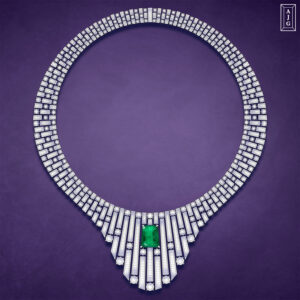
“A straight line, taught to curve.”
This creates one of the fundamental challenges of luxury jewellery design with baguettes: creating movement without losing geometric discipline.
-
Structure as Discipline
A straight line forgives nothing.
There is no rounded edge to soften an error and no flowing curve to hide an inconsistency. Every alignment, gap and junction becomes visible.
The limitation therefore becomes the design brief.
The designer must work with the geometry of the stone rather than fight against it.
“The line doesn’t bend to the design. The design proves itself to the line.”
This precision gives well-designed baguette jewellery its distinctive architectural character. It also makes technical accuracy an essential part of the aesthetic.
-
Story
The baguette carries a story that reaches beyond the diamond itself.
Its linear geometry belongs naturally to the vocabulary of Art Deco, a movement that embraced strong geometric patterns, symmetry and clean, repetitive lines.
That history gives the baguette a narrative language.
It allows a designer to move between architecture and adornment, between structure and ornament.
“Before it was a diamond cut, it was an architectural movement.”
The stone becomes more than a material. It becomes part of the story.
-
Setting Engineering
The technical challenge continues beneath the surface.
The baguette’s 90° corner is its most vulnerable point. At the same time, a closed back can restrict the very light travel that gives the step-cut its character.
Setting must therefore solve two problems at once: protect the stone and allow the light to work.
Every decision matters.
“Protect the edge. Free the light.”
In exceptional baguette diamond jewellery, setting becomes part of the optical and structural design rather than a manufacturing detail added at the end.
-
Design Harmony
A baguette becomes even more expressive when paired with another diamond cut.
Place it beside a round or oval brilliant and the contrast becomes deliberate.
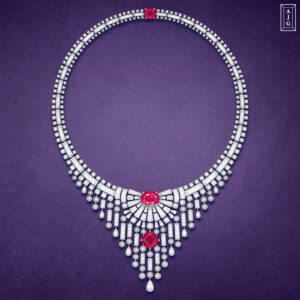
The brilliant scatters light. The baguette returns it in broader flashes. Their shapes create another conversation between softness and structure.
Even the space between them matters.
The gap is not empty metal. It becomes part of the composition, a controlled pause between two different optical languages.
A good diamond jewellery design creates a deliberate relationship between them.
-
Metal & Light
Metal changes the way a baguette is perceived.
Platinum and white gold reinforce its cool, precise character. Yellow and rose gold introduce warmth and soften its strict geometry.
The metal therefore changes the relationship between the diamond and light.
For a high jewellery designer, metal becomes another element in the optical equation. It helps define the character of the design.
-
Wearability as Engineering
There is one final challenge.
The baguette is rigid.
The body is not.
A necklace must move with the neckline. An earring must remain balanced on the ear. A bracelet must flex without losing its structure.
The designer must therefore reconcile geometric precision with human movement.
“Structure that still knows how to move.”
Wearability cannot come at the end of the process. It has to enter the design from the beginning.
The Signature by Amit J Ghosh
These principles form the foundation of The Signature by Amit J Ghosh.
This collection of high jewellery designs, woven around baguette diamonds, does not treat baguettes as a substitute for brilliant-cut diamonds. It begins with the baguette’s own character and asks what happens when its geometry, light behaviour and technical
limitations become the starting point for design.
The result is a study in controlled light, engineered form and architectural thinking.
For us, the baguette is a design language.
A language where geometry creates rhythm, precision creates beauty, and technical discipline becomes part of the luxury itself.
Not sparkle driven. Not decorative.
Structured light. Engineered form. Precision-based beauty.